
The Whole Me: Teaching Digital Citizenship with SEL, Safety & Wellness

Updated: Dec 15, 2025
Why We Designed 'The Whole Me'

When Margot Denommé, former Toronto Crown Attorney and children's book author, visited schools across Canada and the U.S. on her Celebrate You Tour, she noticed a troubling trend: girls comparing themselves to impossible, filtered social-media images and struggling with self-esteem. These experiences inspired her to found Raising Awareness about Digital Dangers (RAADD) and write The Family Smartphone Guide, a practical resource for families to navigate the digital era safely and mindfully.
Through Coralus, Margot met Kendra Bostick, Founder of Kikori, one of six U.S. ventures selected for their innovative SEL programs. Kikori created experiential team-building activities to complement Margot’s books, Mommy am I Pretty? and Celebrate You Inside & Out!, giving students a way to explore identity, empathy, and self-expression in a meaningful, hands-on way. Working in schools as a School Social Worker and through Kikori to support school-wide SEL integration, Kendra has seen first-hand the ways in which screens and social media impact students and create significant disruptions to student's ability to self-regulate and focus, their mental health, and their relationships.
Margot began presenting to schools around the world, on the Global News, and at school boards across Canada around the digital dangers that students were facing - issues with self-regulation, mental health needs and safety concerns. Each time she presented, educators asked:
“How do we teach this? Where is the curriculum?”
The result? 'The Whole Me,' a Digital Citizenship, Safety, and Wellness Curriculum for grades 3-12 that blends SEL and technology, giving students the skills to navigate the digital world confidently, safely, and thoughtfully.'
Why Traditional Digital Citizenship Isn’t Working - And What We Can Do Instead
For years, digital citizenship has been taught the same way:
“Don’t share this.”
“Don’t click that.”
“Report unsafe content.”
These lessons check a compliance box, but they don’t actually prepare students for the messy, emotional, real-world digital lives they’re living every day.
Because the truth is this:
👉 Students don’t need more rules.They need real skills.
Skills that help them regulate emotions, understand relationships, think critically about what they see online, and use technology in ways that feel healthy — not overwhelming.
And right now, that part is missing.
The Hidden Cost of Rule-Based Digital Citizenship
If you walk into most classrooms, you’ll see the same thing: students that are overwhelmed, distracted, tired, and disengaged.
They’re navigating:
Constant notifications
Social comparison on repeat
Online drama and cyberbullying
A nonstop stream of content designed to hijack their attention
Emerging technologies like AI that even adults struggle to keep up with
Research paints a clear picture:
Teens spending 4+ hours/day on recreational screen time show higher symptoms of anxiety and depression (CDC, 2025).
Passive scrolling is linked to increased emotional and behavioral issues (Computers in Human Behavior, 2025).
Social media can fuel identity confusion and distress for adolescents (Systematic Review, 2024).
And yet, when we “teach digital citizenship,” we hand students a list of dos and don’ts. No wonder it doesn’t stick. Students may know the rules, but they don’t have the skills to use them.
The Cyberbullying Reality Check
These gaps show up in real ways:
46% of teens report experiencing cyberbullying (Pew, 2022).
1 in 6 children ages 11–15 say they’ve been targeted online (OECD, 2022).
Girls and students in single-parent or lower-income households are especially vulnerable.
It’s not enough to say, “Be kind online!”
Kids need the emotional tools behind that kindness: empathy, self-awareness, self-regulation, and the ability to think before they react.
This is where traditional digital citizenship falls short —
and where a new approach is urgently needed.
Introducing The Whole Me: A Whole-Child Approach
What if digital citizenship didn’t feel like a lecture?
What if it felt like a hands-on adventure —
full of creativity, connection, reflection, and real-life relevance?
That’s the idea behind 'The Whole Me,' a digital citizenship, safety, and wellness curriculum that blends:
🌱 Social-emotional learning
🧠 Brain science & digital wellness practices
🌐 Digital citizenship & media literacy
🎨 Creative expression
👟 Real-world application
Because kids learn best when they can experience, reflect, and practice.
Not when they’re told what not to do.
What Students Learn in The Whole Me
Instead of focusing on fear-based warnings, students dive into skills that matter:
Digital identity and footprints
Brain-friendly tech habits
Media literacy & misinformation
Online empathy & communication
Words, consequences & viral trends
Algorithm awareness & mindful scrolling
AI bots, deepfakes & emerging tech
Personal safety & boundaries
Rewilding & mindfulness
Self-affirmation, confidence & leadership
It’s everything students actually need — in the format they deserve.
How the Learning Comes Alive
Every module includes four parts:
Experiential Activity Think fun, interactive, “let’s try this together.”
Core Lesson Real talk about real digital experiences.
Creative Expression Art, storytelling, or making something meaningful.
Real-World Application Family plans, role-plays, pledges, or strategies they can use immediately.
This structure is grounded in Kolb’s Experiential Learning Cycle, which is proven to increase retention, build deeper understanding, and help students transfer what they learn to real life.
In other words:kids don’t just learn digital citizenship — they live it.
Does It Work? Absolutely.

The research behind experiential + SEL-based digital citizenship is strong:
SEL-infused digital interventions improve empathy, responsibility, and emotional regulation (Innovating SEL for Social Media, 2024).
Social media identity research shows students need emotional support to navigate online spaces (Systematic Review, 2024).
Screen-time studies consistently show wellness and mental health impacts (CDC, 2025; Dai & Ouyang, 2025).
The Bottom Line
Students don’t need another list of digital rules.
They need skills, confidence, and support to navigate the digital world with empathy, agency, and balance.
The Whole Me gives them exactly that -
a learning experience that’s joyful, hands-on, emotionally grounded, and truly meaningful.
Because digital citizenship isn’t just about avoiding harm.
It’s about helping students become the healthiest, kindest, most empowered version of themselves - online and off.
Free Download: Holiday Deep Breath Activity + Reflection Guide
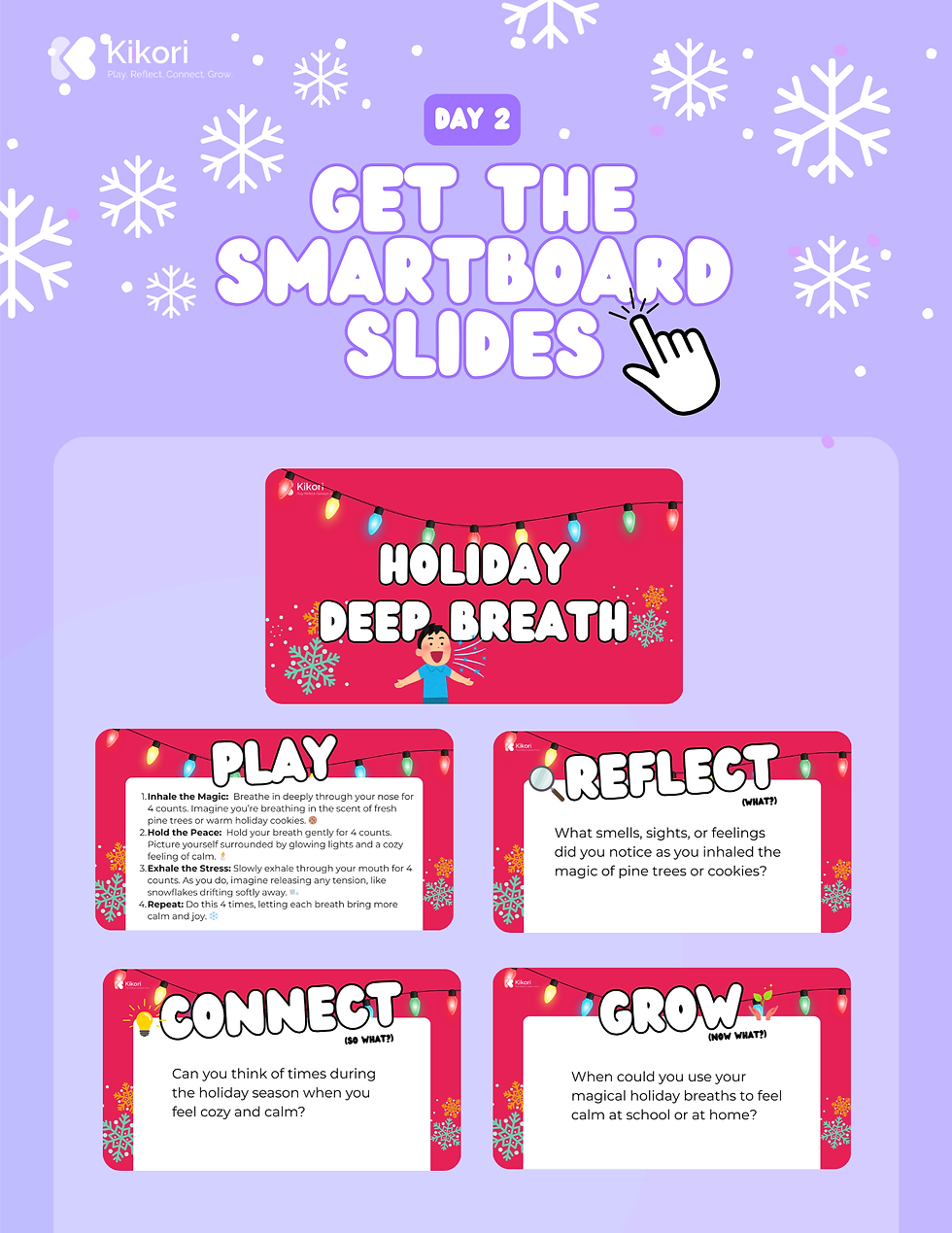
Our Day 2 SEL-ebration free activity is Holiday Deep Breath! Invite your students to take a cozy, screen-free pause and notice the joy and calm that comes from simply stopping, breathing, and being present.
✨ Free Printable: “Holiday Deep Breath Activity + Reflection Sheet”

Bring The Whole Me to Your School
Digital citizenship shouldn’t just be a lesson - it’s a lifestyle.
Bring The Whole Me curriculum to your school and watch experiential SEL transform your students’ digital lives. Empower students, engage families, and create a community-focused approach to digital wellness.

I explored the interface briefly, and it gives off a very polished feel. The layout is clean, and getting from one section to another is seamless.
I spent a few minutes on the interface, and I liked what I saw. It’s balanced, user-friendly, and doesn’t overwhelm you with too much at once.
After browsing through the interface, I can say it’s well put together. It’s clean, easy on the eyes, and simple to move between different sections.
I checked the interface for a bit, and it’s quite impressive. Everything feels neatly arranged, and navigating around is really straightforward.
https://www.servicedapartmentinbangalore.co
m/
I had a chance to explore the interface, and it feels thoughtfully designed. Not cluttered, but still packed with useful info—switching sections is effortless.
https://www.gfegirls.com